
Women's Wallet: The Complete Guide 2026

Looking for THE right women's wallet? Companion, zippered, cardholder, flap — we help you find the wallet that really fits your life and style, without paying the price of a handbag.
You open your bag. Your wallet is stuffed with about ten expired loyalty cards. The zipper refuses to close. The inner lining tore last week. And it clashes with your cream suit with its black color bought without thinking 4 years ago. Classic.
A well-chosen women's wallet is the accessory that follows you for 5 to 10 years. But between the long leather companion at €200, the minimalist cardholder at €40, and the hybrid wallet clutch at €25, how do you know which one suits you? This guide gives you all the keys — including the smart option if you don’t want a classic wallet.
What is a women's wallet?
A women's wallet is the accessory designed to carry your payment methods, your cards (ID, loyalty, transport, bank), and sometimes some bills and coins. Its particularity is not so much its volume — a pouch would do just as well — but its internal organization: precise slots for each card, pockets for bills, a compartment for coins. You reach in, you find.
Historically, the women's wallet was a utilitarian black leather item, folded in two, opened to pay. Today, it has completely changed its look. You can find long-format evening clutch companions, ultra-thin cardholders that fit in a jean pocket, quilted pouches that serve as both wallet and evening clutch. The wallet has become a full accessory, chosen as much for its look as for its function.

Its purpose, then: to hold what secures your day. Bank card, ID, transport, loyalty cards, bills, coins. It's the accessory you take out between 5 and 15 times a day — and the fact that it's both beautiful AND practical really changes your daily experience.
Why you deserve better than a basic wallet
Before having a thoughtfully designed wallet, you think a small €8 coin purse is enough. Three months later, you know better. Here are the four concrete reasons why a good wallet makes a huge difference.
You pull out the right cards on the first try
This is point number one. A well-organized wallet has visible slots for each card (angled slots, transparent ID window). You know where the bank card is, where the transit card is, where your loyalty cards are. You pull out the right one on the first try. No digging at the checkout while the line grows.
Your bills don’t get damaged
A catch-all coin purse ends up with bills folded in eighths in a compartment that's too small. A real wallet has a dedicated bill compartment, the right size (at least 14 cm long for euro bills), often lined to prevent wear. Your bills stay neat, more presentable to pull out.
It lasts 5 to 10 years
A low-end €8 wallet: lining cracks after 6 months, zipper breaks after 12 months. A well-made wallet (grained leather, reinforced quilting): 5 to 10 years of daily use without complaint. Over 10 years, do you buy 15 times or once? The math is easy.
It says something about you
Let's be honest: at a café terrace, the wallet you pull out sends a message. A black faux leather coin purse with a broken clasp says something different than a grained leather companion or a patterned quilted clutch. It's not about price — it's about coherence with who you are.
The 6 types of women's wallets
Not all wallets are equal — nor are they worn the same way. Here are the six main types, with their uses, strengths, and limitations.

The travel companion (long format)
The most classic and generous format. Rectangular long format (~19 × 10 cm), opens like a large book, holds 12 to 20 cards, a large bill compartment, a zipped coin pocket. This is the maximum organization option.
- Capacity: 12 to 20 cards + bills + coins + checkbook
- Ideal for: "complete" women who carry ID, bank, transport, loyalty cards, health insurance
- Strength: everything is stored, super organized, statement piece
- Note: bulky format that requires a large bag, not practical in a mini bag
This is the format to choose if you really want to carry everything and you use medium to large bags. It’s also the most versatile classic to gift.
The classic zip wallet
Compact format (~12 × 10 cm), opens with a zipper that goes all around. Capacity for 6 to 10 cards + folded bills + integrated coin compartment. This is the ultimate versatile format.
- Capacity: 6 to 10 cards + bills + coins
- Ideal for: standard daily use, medium handbag
- Strength: compact, secure (zip around), affordable price
- Note: limited capacity, less convenient to use at checkout (you have to unzip everything)
This is the most common format in general stores. It works for 80% of women — not too bulky, well organized enough.
The minimalist cardholder
Small format (~10 × 7 cm), ultra-thin, accordion or linear angled slots. No bill compartment, no coin compartment — just the essential cards (4 to 6).
- Capacity: 4 to 6 cards
- Ideal for: minimalist women, clutch dinners, mostly contactless payments
- Strength: ultra-light, fits anywhere (jeans pocket, mini bag), elegant
- Note: not suitable if you carry many cards or coins
The fastest-growing format since the rise of phone payments. If you mostly pay with Apple Pay and carry 3-4 physical cards (bank + ID + transport), it’s more than enough.
The flap wallet
Compact format (~13 × 9 cm) with a flap that closes with a magnetic clasp or snap button. Interior card slots, bill compartment, sometimes a mini coin pouch.
- Capacity: 6 to 10 cards + bills
- Ideal for: daily use, chic look, formal professional contexts
- Strength: very elegant, quick one-handed opening, "classic chic" look
- Note: less secure than a zipper if the clasp gives way
This is the preferred format for formal professional settings — it has a "companion" feel that inspires trust without the bulkiness of the long format.
The accordion wallet
Compact format that unfolds accordion-style, revealing a bunch of card slots visible at a glance. Often closed with an elastic band or a side zipper. Chic-original format.
- Capacity: 8 to 16 cards (depending on models)
- Ideal for: very organized women, many cards (transport, loyalty)
- Strength: total card visibility, compact format, original look
- Note: less discreet when you open it in public
This is the format for the "queens of organization" who want to see all their cards at a glance. Not for minimalists.
The clutch wallet (hybrid)
Evening clutch format (~17 × 11 cm) with wallet organization inside. It’s the 2-in-1 accessory: you can carry it inside a larger bag daily, and take it out as an evening clutch with an attachable chain.
- Capacity: 6 to 12 cards + bills + small items (lipstick, slim phone)
- Ideal for: women who want a single accessory that works daily AND for going out
- Strength: absolute versatility, glamorous format
- Note: less technical than a specialized wallet
This is our favorite format for those who don’t like accumulating accessories. Daily, it’s an organized wallet. In the evening, you take off your bag, grab just the clutch with a chain—and head out.
The 8 criteria to choose well
Beyond the type, here are the eight criteria that make a wallet perfect for you—or disappointing after 6 months.
1. The number of card slots
This is the most practical criterion. Count your current cards (after the sorting we did above). Primary bank card, secondary bank card, ID, transport, health insurance, priority loyalty cards (2-3 max). Generally, 6 to 10 slots cover needs well. Beyond that, it's unnecessary accumulation.
2. The size of the bill compartment
Must be at least 14 cm long to hold a standard euro bill without folding it into eighths. Ideally 15-16 cm for some ease. Beware of small coin purses that fold bills—they wear out quickly and end up crumpled.
3. The presence of a zippered coin compartment
If you still regularly use coins (bakery, market, vending machines), a zippered coin compartment is essential. Without a zip, coins wander at the bottom of the bag. Make sure the closure is secure and the opening wide.
4. The main closure
Three options: zip all around (maximum security, but slow to open), magnetic flap (quick, but less secure), snap button closure (intermediate). Choose based on your security vs. speed of use compromise. For urban life on the metro, favor the zip.
5. Material
This is the longevity criterion. A real material (leather, reinforced quilted) lasts 5 to 10 years. A low-end faux leather cracks after 12 months. More details below in the material section.
6. External size
Measure the wallet BEFORE buying. It must fit comfortably in YOUR main bags — not in a theoretical bag. A large companion won't fit in a mini bag. A cardholder floats in a tote. Real use matters more than the theoretical beauty of the item.
7. RFID protection (gadget or useful?)
More and more wallets include RFID protection that prevents remote reading of your bank cards. Real usefulness is limited (RFID attacks are rare in practice) but it costs nothing extra nowadays. Consider it a bonus, not a deal-breaker.
8. Style consistent with your bag
You'll take it out 5 to 15 times a day. If it doesn't match your bags (color, pattern, style), you'll end up not liking it. Choose it thinking about YOUR current bags — not an ideal "perfect wallet" disconnected from your daily life.
Which material to prioritize
Not all materials are equal. Here are the main options.
Grained leather
The top material for women's wallets. Lasts 10 to 20 years with good care. Develops a patina. Available in all colors and textures (smooth, grained, suede). It's the classic investment par excellence.
- Advantages: exceptional longevity, unique look, patina
- Limitations: high price (€80-300), requires maintenance (cream 1-2 times a year)
- Ideal for: a wallet "that follows you through your entire active life"
Quilted cotton
Modern format, aesthetic, varied patterns. Lighter than leather, much more affordable. Very pretty as a hybrid wallet clutch. Lasts 3 to 5 years with heavy use.
- Advantages: very affordable price (€15-40), variety of patterns, aesthetic appeal
- Limitations: less durable than leather, can stain
- Ideal for: a "fun" wallet to match with your bags, or as a complement to a leather companion
High-grade faux leather (PU)
Good quality imitation leather. Visual and tactile feel close to real leather, but without patina and with a shorter lifespan (2 to 5 years depending on use). Preferable as an ethical alternative to leather for those who do not want animal leather.
- Advantages: non-leather option, mid price (30-80€), "leather" look
- Limits: no patina, may crack after 3-4 years
- Ideal for: leather-free alternative, mid-range budget
Waterproof velvet
Very chic look, rarer in wallets. Unique, elegant touch. More fragile than other materials.
- Advantages: unique aesthetic, exceptional feel
- Limits: marks quickly, high price, delicate care
- Ideal for: occasional or going-out wallet
To avoid for a wallet
Low-end faux leather (cracks in 6 months). Shiny plastic wallets that peel. "All-over logo" wallets that date quickly. Fragile plastic zippers.
How many cards you really need to carry
The classic mistake: carrying 20 cards "just in case." Here's the real minimum list + variable depending on your use.
The bare minimum
- Identity card (CNI) or driver's license
- Main bank card
- Health insurance card or mutual insurance card
- Transport card (Navigo, dematerialized ticket)
Total: 4 cards. This fits comfortably in a minimalist cardholder.
The "very useful"
- Second bank card (joint account, professional card)
- Student card (if applicable)
- Main loyalty card (the most used — your bakery or supermarket card)
Total: 7 cards. This is the standard classic zip wallet.
The "I also have these"
- Secondary health insurance cards
- Cinema card
- Parking card
- 2-3 less-used loyalty cards (max)
- Unused gift cards
Total: 10-12 cards. This is the long-format companion.
What should NOT be in your wallet daily
- Boat license, other special permits (to leave at home or in a separate organizer)
- All unused loyalty cards (Sephora from 2 years ago, Subway from 2019…)
- Important documents (passport, vehicle registration, school certificate — to keep in a home organizer)
- Family photos (also at home)
Sorting every 6 months keeps your wallet elegant and functional — instead of turning into an archive box.
Which size for which use
The right size completely depends on YOUR use. Here's a practical reference.
For daily handbag use
The classic zip wallet (12 × 10 cm) or the hybrid wallet pouch (17 × 11 cm). It's the sweet spot for most women: enough space for essential cards + bills + coins, without cluttering the bag.
For minimalist use (contactless payment)
The minimalist cardholder (10 × 7 cm). If you mostly pay with Apple Pay or Google Pay and carry just 4-6 physical cards, it’s perfect. You can slip it into a jean pocket, a mini-bag, or the inside pocket of a blazer.
For travel and special occasions
The long companion wallet (19 × 10 cm). When you travel, you carry more cards (secondary SIM card, travel insurance card, foreign currency). The long companion offers space and organization for everything.
For outings / dinners
The hybrid wallet clutch (17 × 11 cm). You can carry it alone as an evening clutch (with an attachable chain or in hand), it holds essentials (cards, bills, coins, lipstick, slim phone). No need for a separate mini-bag.
For formal professional contexts
The classic flap wallet (13 × 9 cm) in grained leather. Impeccable look, elegant one-hand opening, subtle visual authority. Ideal for client lunches or business meetings.
Classic wallet vs quilted clutch: the real question
This is THE question few guides address. Do you really need a “classic” leather wallet, or does a quilted clutch do just as well?
When a classic wallet is worth it
- You carry many cards (10+) and really use several daily
- You work in a formal professional environment (firm, bank, consulting)
- You want an item that lasts 10-20 years without changing
- You appreciate the patina and evolution of leather over time
- You give and want a gift that’s an “investment”
When a quilted clutch does the job perfectly
- You carry 4-8 cards for daily use
- Your professional environment is creative or casual
- You like to change accessories according to the season
- You want a 2-in-1 item (wallet + evening clutch)
- You value affordable price and variety of patterns
Our stance at Bokabas
We don’t offer a classic leather wallet — and that’s intentional. We prefer to offer you quilted ruffle clutches (€15) that serve as both an organized coin purse AND an evening clutch. In the long run: you pay 6 to 10 times less than a leather companion wallet, you can change patterns with the seasons, and you get an item that works in more contexts (handbag + evening out).

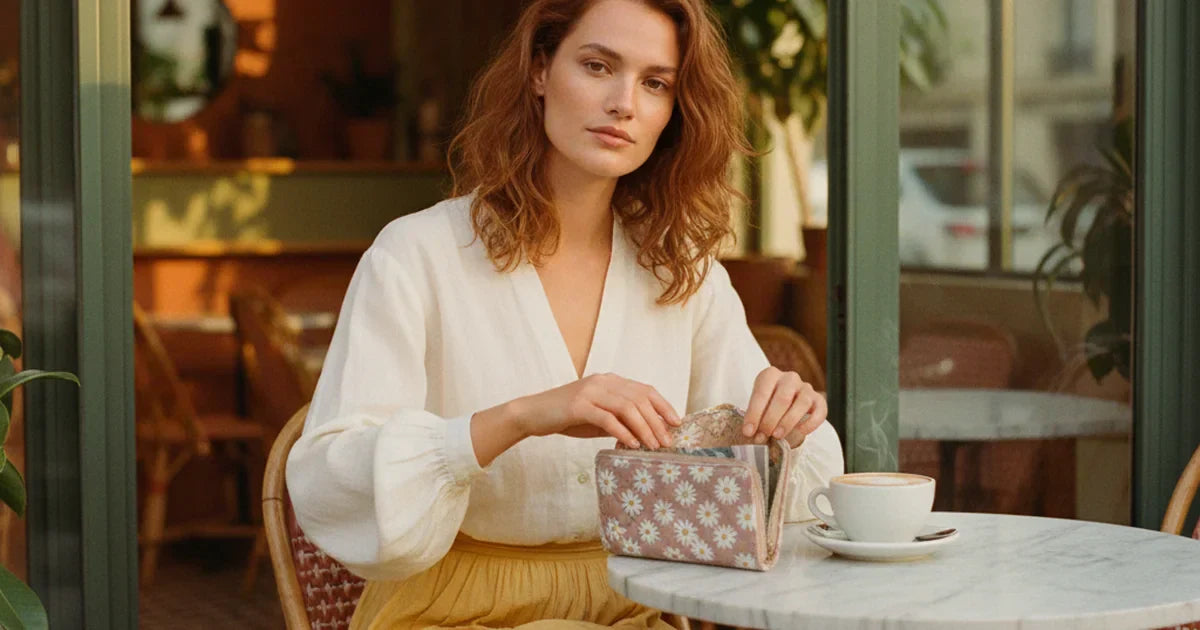
Here’s concretely how the Bokabas quilted clutch can replace a classic wallet in daily life:
- Main compartment: a large open space that holds loose cards, bills, slim smartphone
- Clutch size: 17 × 11 cm, fits all medium to large handbags
- Secure zipper closure: no risk of loss
- Variety of patterns: 14 different patterns to match your bags or your mood of the day
For those who carry lots of cards: add a mini cardholder pouch inside (5-15€ at haberdashery or entry-level leather goods). You get an organized setup that rivals a €200 leather wallet.
Quilted Ruffle Clutch Leopard
€15
VIEW PRODUCTHow to match with your bag
A beautiful wallet is good. A wallet that matches your bag is better.
Coordinate the patterns
If you mainly carry bags with strong patterns (leopard, daisy, flowers), a quilted clutch in the same or a complementary pattern creates immediate harmony. You take out the clutch, it doesn’t clash with the bag.
Coordinate the tones
For those who prefer solid bags (black, beige sand, camel brown, navy), the wallet can be a pop of color (burgundy, sage green, terracotta). It adds life without breaking coherence.
Themed sets
If you love coordinated looks: wallet clutch + toiletry bag + pencil case in the same pattern. It’s the full set you see on those who have a very deliberate approach to their accessories.
Cream or camel, safe bets
If you hesitate, a cream or camel wallet goes with absolutely everything. Cream for those who carry dark or colorful bags (elegant contrast). Camel for those who carry neutral or warm-toned bags.
Avoid "all-over logos"
Wallets with repetitive logos (LV, Gucci monogram, etc.) date your accessory as soon as it goes out of style. Favor natural patterns (animal prints, flowers, geometric) that don’t rely on a "brand" effect to exist.
Quilted Ruffle Clutch Daisy
€15
VIEW PRODUCTThe 5 mistakes to avoid
Some classic pitfalls when buying — and how to avoid them.
1. Buying too big "to have some margin"
This is the number one mistake. You buy a long-format wallet because it has "lots of space." You end up putting useless cards just to fill the space. Aim for the size that matches YOUR real current needs — not an ideal future version.
2. Choosing only based on price
A wallet at €8 that breaks after 6 months costs you more than a €40 wallet that lasts 5 years. Also add the psychological cost (an accessory that deteriorates is demoralizing to handle).
3. Choosing a logo that's too visible
"All-over logo" wallets date your accessory and weaken its harmony with your wardrobe within 12-18 months. Favor patterns or materials that don't rely on trends to exist.
4. Forgetting to measure your main bag
A beautiful long wallet that doesn't fit in your handbag is an unused item. First measure the inner pocket of your main bag, then look for a wallet that fits comfortably.
5. Buying "the most complete" when you're minimalist
If you mostly pay by phone and carry 4 cards, a 20-slot wallet is overkill. Conversely, if you have 10 really useful cards, a minimalist cardholder will frustrate you. Match the size to your actual habits, not your organizational fantasy.
How to care for your wallet
A well-maintained wallet lasts twice as long. Here's how to care for it depending on the material.
For a leather wallet
- Daily: wipe with a dry cloth if exposed to moisture during the day
- Monthly: soft, slightly damp cloth, never direct water
- Annual: nourishing cream (like Saphir Renovator) or leather cleansing milk, 1-2 times a year
- Storage: in a cotton dust bag, away from direct light
For a quilted cotton wallet
- Daily: no maintenance needed
- Monthly: damp cloth + mild soap on marked areas
- Quarterly: machine wash at 30°C in a protective mesh bag (check the label), dry flat
- Storage: clean and dry, protected from dust
For a faux leather wallet
- Daily: no maintenance needed
- Monthly: damp cloth + mild Marseille soap
- Annual: avoid leather creams that can damage the coating
- Storage: dry, protected from humidity
In case of stain or wetness
- Wet leather: air dry, never near a heat source, then condition within 48 hours
- Stained cotton: pre-treat with Marseille soap, machine wash at 30°C
- Faux leather: blot immediately, never rub, use mild soap if stain persists
Storage between uses
When you no longer use a wallet (season change, vacation period), store it clean, dry, empty. Slip it into a cotton cloth in a dry place. Do not store a wallet filled with cards you no longer use — it can mark the leather or compress the padding.
FAQ — Everything you need to know about women's wallets
What size women's wallet should you choose?
First count your essential cards. If you have 4 to 6 (mostly phone payments), a minimalist cardholder of 10 × 7 cm is enough. If you have 6 to 10, a classic zipped wallet of 12 × 10 cm is perfect. If you have 10+ or carry many bills, a long companion wallet of 19 × 10 cm. Also check it fits in your main handbag before buying.
Women's leather wallet or quilted: which to choose?
Grained leather is the longevity option (10-20 years with care) but costs €80-300. Cotton quilted is the aesthetic-price option (€15-40) that lasts 3-5 years with heavy use, with many patterns available. For a long-term investment: leather. For a fun item to change with the seasons: quilted. Many women have both for different uses.
What budget for a good women's wallet?
Expect to pay €15 to €40 for a quality cotton quilted pouch (lasts 3-5 years). €40 to €100 for good quality faux leather or a minimalist leather cardholder. €80 to €200 for a classic quality leather wallet. €200 to €500+ for high-end leather goods brands or long full-grain leather companions. Below €12, stitching and lining quality is generally insufficient.
How many cards in a women's wallet?
On average: 4 cards minimum essential (ID, main bank card, health card, transport), 6-8 cards for typical use (add 2-3 loyalty cards + secondary bank card), 10-12 cards maximum recommended. Beyond that, you accumulate cards you don’t use. Sort through them every 6 months — discard expired or unused loyalty cards.
How to choose a leather wallet?
Look for grained leather (more resistant to scratches than smooth leather), fine and regular stitching (a sign of quality), a leather or thick fabric inner lining (not thin plastic), and well-sized card slots (cards shouldn’t slide freely). Expect to pay €80-200 for real durable quality. Reliable brands: Le Tanneur, Petit Bateau, Lancaster, Polène, or independent full-grain leather leather goods makers.
Can you use a pouch as a wallet?
Yes, absolutely — and it's an excellent option if you carry 4-8 cards and want a 2-in-1 item. A quilted pouch measuring 17 × 11 cm comfortably holds cards, bills, a slim smartphone, and a small item (lipstick, keys). When going out, you take off your handbag and just take the pouch as an evening accessory. It's more versatile than a classic wallet.
Wallet with or without coin compartment?
If you regularly use coins (bakery, market, vending machines), a zipped coin compartment is essential — otherwise coins roll around at the bottom of the bag. If you pay almost exclusively by card or phone, a wallet without a coin compartment (cardholder or slim companion) is enough. Adapt to actual behavior.
Which women's wallet brand to choose?
Classic leather brands (Le Tanneur, Petit Bateau, Lancaster, Sézane, Polène) for longevity of 10-15 years. Accessible fashion brands (Bokabas, Cabaia, Mademoiselle Mademoiselle) for style and affordable price. High-end leather goods houses (Longchamp, Lancel) for the statement. Avoid general "fast fashion" brands that release models at €12-15 — quality does not follow.
How to clean a leather wallet?
First, remove all contents. Wipe the exterior with a soft, slightly damp cloth, without soaking the leather. For durable brands, use a leather cleaning milk (Saphir, Famaco). Air dry, never use a hairdryer. Then apply a nourishing cream to rehydrate the leather. Store in a dust bag, away from direct light.
Should you give a wallet to your mother / sister / a friend?
Great gift idea — it's an item used every day, so you maximize usage frequency. A few tips: if you're unsure about the material, choose patterned cotton quilting (more versatile than a specific leather). If you know the person's style well, go for grained leather in a neutral color (camel, sandy beige). Avoid very bold colors if you're not sure of their preferences.
The Bokabas Selection
At Bokabas, we offer about fifteen quilted ruffle clutches that serve as both everyday wallets and evening clutches. Here are our favorites to start with.
Quilted Ruffle Clutch Leopard
€15
VIEW PRODUCTQuilted Ruffle Clutch Daisy
€15
VIEW PRODUCTQuilted Ruffle Clutch Cherry
€15
VIEW PRODUCTThe size is the same for all our designs (€15, zipper, size 17 × 11 cm) — only the personality changes. You choose according to your mood, your handbag, your suitcase. And you often take several — because at this price, it's also a nice gift to give.
Women's Wallet Collection
16 models available
DISCOVER THE COLLECTIONAlso read: How to Choose a Women's Handbag
---

Leave a comment
This site is protected by hCaptcha and the hCaptcha Privacy Policy and Terms of Service apply.