
Diaper Bag: The Complete Guide 2026

Looking for the right baby diaper bag? Backpack style, carry-all, mini bag, or quilted tote — we help you find the bag that really follows you everywhere, without looking like an expedition.
You go out with baby. You put a diaper in one pocket, wipes in another, the bottle in your handbag, the change of clothes in a tote bag. Three minutes later, you’re looking for the bottle in the bag where you put the wipes. Classic.
A well-designed diaper bag means the end of that chaos. But between the expedition-style giant bag, the tiny handbag that holds nothing, and the technical backpack sold for €200, it’s hard to find your way. This guide gives you all the keys to choose THE bag that really fits your daily life — not forgetting smart alternatives, because a beautiful quilted tote can very well do the job of a dedicated diaper bag.
What is a diaper bag?
A baby diaper bag is a bag designed to carry everything your baby needs when out: diapers, wipes, bottles, a change of clothes, a comfort toy, and sometimes a bit more if you're out for the day. Its specialty isn’t so much its volume — a large tote does just as well — but its internal organization. Dedicated compartments, insulated pockets, stroller attachments: everything is designed so you don’t have to search while the baby cries.
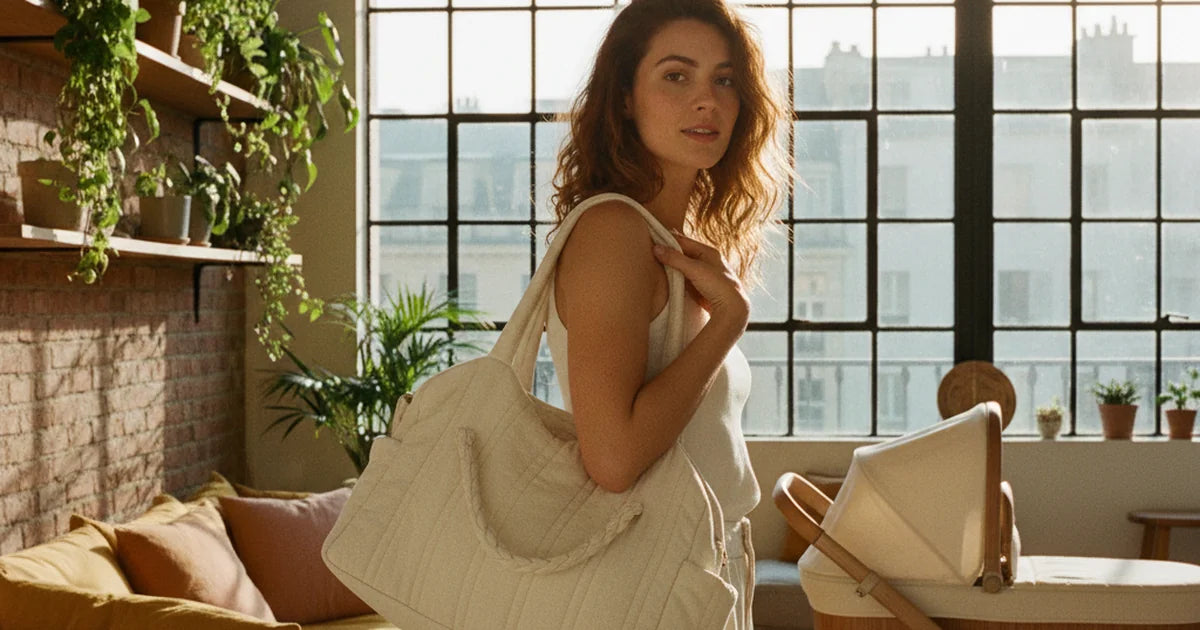
Historically, the diaper bag looked like a large shapeless bag with very 90s "baby" patterns. Today, it has completely changed its look. Brands release models that look like chic totes, urban backpacks, quilted carry-alls. You can wear it at 35, at 25, in jeans or a dress, without looking like you've signed up for five years of visible motherhood.

Its purpose, then: to cover all outings with baby. The one-hour walk in the park. The day at the grandparents'. The restaurant outing. The weekend. The pediatrician appointment. In short, anything that lasts more than five minutes outside your home.
Why a (real) diaper bag changes your life
Before becoming a mom, you think a big handbag will be enough. Three outings later, you know better. Here are the four concrete reasons why a dedicated — or well-organized — bag makes a huge difference every day.
You find everything in 2 seconds
This is the number one point. When the baby screams in the stroller because they’re hungry, you don’t want to rummage through an opaque carryall for two minutes. A diaper bag designed for this has dedicated compartments: one for diapers, one for wipes, an insulated pocket for the bottle, a zipped pocket for your wallet. You reach in, you find it.
You carry it comfortably, even when loaded
A fully packed diaper bag easily weighs 3 to 4 kg. If you carry that on a thin shoulder strap for two hours, your back will feel it. Real diaper bags have wide straps, sometimes padded, and often an option for an adjustable shoulder strap or backpack carry. It makes a huge difference over time.
You clip it onto the stroller in one snap
Most dedicated models include stroller straps: two elastic attachments that clip onto the handles. Baby is in the stroller, the bag on the handles, your hands free. It’s so basic yet so transformative that you wonder how you managed before.
You can change the baby anywhere
Many diaper bags come with a built-in changing mat, folded and slipped into a dedicated pocket. You unfold it on any surface — park bench, questionable public changing table, car backseat. It’s the accessory you forget to add to your list and regret as soon as your first long outing.
The 6 types of diaper bags
Not all diaper bags are equal — nor are they worn the same way. Here are the six main categories, with their uses, strengths, and limitations.

The diaper backpack
This is the size that has grown the most in recent years. Urban backpack shape, sometimes with a wide-angle suitcase-style opening, several organized compartments, ergonomic straps. You wear it hands-free, which changes everything as soon as the baby wants to be held or when you push the stroller uphill.
- Capacity: 18 to 28 liters
- Ideal for: long days, public transport trips, parents who walk a lot
- Strength: exceptional comfort, hands-free, urban look
- Note: less glamorous than a tote in the evening, taking out the bottle requires setting the bag down
In practice, this is the format to choose if you prioritize comfort and carry your bag for more than two hours straight. It's also dads' favorite, who often struggle with all-in-one formats to carry on the shoulder.
The all-in-one diaper bag (tote)
Large bag open at the top, tote format, two medium handles to carry on the shoulder or by hand. This is the classic diaper bag format—the one you picture when you say "diaper bag." Today, it has evolved a lot: quilted, elegant patterns, refined finishes.
- Capacity: 20 to 30 liters
- Ideal for: short to medium outings, moms who like the tote format, chic look
- Strength: very accessible, top aesthetics, versatile beyond the baby
- Note: open at the top = less protected in rain, sometimes too heavy on one shoulder
It's also the format that most easily transforms into an everyday bag once the baby becomes more independent. A beautiful quilted tote remains a beautiful tote when you no longer need to carry diapers.
The crossbody diaper bag
Flatter, more structured, with a long adjustable strap to wear crossbody. Often rectangular in shape, sometimes equipped with a flap. It's the compromise between a handbag and a diaper bag.
- Capacity: 12 to 20 liters
- Ideal for: short outings, city lunches, moms who like to keep a handbag look
- Strength: remains elegant, comfortable to carry on one shoulder thanks to the long strap
- Note: limited capacity, often simpler interior organization
It's an excellent second bag, to use for outings of one to two hours when you don't need to carry everything. If you only have one bag, aim bigger.
The hybrid diaper bag (2-in-1)
A bag that transforms according to use: you can wear it as a backpack, crossbody, or handbag depending on how you place the straps. Often smart in terms of compartments, with very well thought-out pockets.
- Capacity: 20 to 25 liters
- Ideal for: undecided, couples sharing the bag, multi-mode parents
- Strength: total versatility, adapts to context and wearer
- Note: design sometimes compromised for versatility, often higher price
It’s the Swiss army knife of diaper bags. You go out in nature with a backpack in the morning, return to the restaurant with a crossbody in the evening, hand it to your partner as a backpack for the trip back. No other format does that.
The mini diaper bag
Small compact size for very short outings: just two diapers, wipes, one bottle, minimal change of clothes. Often worn crossbody or as a clutch. It’s the ally for trips under an hour or family dinners.
- Capacity: 6 to 10 liters
- Ideal for: short outings, dinners, walks near your home
- Strong point: ultra discreet, no unnecessary weight
- Note: does not cover a full day, to be supplemented with another bag for long outings
To have as a complement, not a replacement. You take the mini for the market, the large one for the day at the grandparents'.
The hack: tote, weekender, or XL pouch
And then there’s the smartest solution — especially if you want your bag to last beyond the baby period. A large, well-organized quilted tote, or a medium-sized weekend bag, makes an excellent diaper bag provided you outfit it well. You slip in a vanity case for care items (wipes, cream, physiologic serum), a medium pouch for bottles, and you have your homemade diaper bag — which will remain your weekend bag or everyday tote for ten years.
This is the approach we favor at Bokabas: you can totally use one of our quilted totes (€55) with a vanity case (€39) and a large pouch (€19) inside. You get an organized, beautiful setup that will never have the “young mom accessory” vibe you regret in six months. We'll talk more about this below with concrete combos.
Also read: How to Choose a Women's Handbag
The 8 criteria to choose your bag well
Beyond the type, here are the eight criteria that make a diaper bag perfect for you — or disappointing by the second week.
1. Capacity (in liters)
This is the starting point. Aim for actual capacity, not apparent size.
- 6-10 L : short outings, dinners, one-hour walks
- 12-20 L : half days, city lunches
- 20-25 L : full days, short trips
- 25-30 L : newborn, first months (lots of gear), weekends
For a newborn, plan generously. You carry more at 2 months than at 18 months — not the other way around.
2. Interior organization
Compartments, pockets, accessibility. A good diaper bag has at least: 1 main compartment, 2-3 side pockets for bottles, 1 insulated pocket, 1 secure zip pocket for keys/wallet, 1 quick outer pocket for emergency diapers. We'll detail this below.
3. Wearing comfort
Wide, sturdy handles, padded shoulder strap if possible, ergonomic back for backpack styles. If you carry it for more than an hour, this becomes critical. Test it in-store with weight inside — an empty bag gives a false idea of comfort once loaded.
4. Water-repellent material (or not)
Baby spills. Bottles leak. Rain falls. A water-repellent or waterproof material often saves the day. Quilted polyester, technical nylon, or coated canvas are really practical. Avoid untreated materials if you go out in all weather.
5. Stroller straps
Small detail, huge difference. Elastic straps with clips that attach to stroller handles = hands-free as soon as baby is settled. If they’re not built-in, buy a separate compatible set: it costs €10 and changes everything.
6. Included changing mat
90% of dedicated models include one. Check that it’s detachable, easy to clean (washable or wipeable material), and has a sufficient size for your baby. The tiny 40×30 cm mat is useless after 6 months.
7. Built-in insulated bag
An inner insulated pocket or a small removable insulated pouch lets you keep a bottle warm for 2-3 hours, or a ready-chilled bottle in summer. It’s a must if you’re out all day and your baby is bottle-fed.
8. Style
Let’s be honest — you carry a diaper bag every day for 2 to 3 years. If you don’t find it attractive, you won’t carry it. Choose one you’d also use without a baby. Ideally, a size that will survive the baby phase to become your everyday or weekend bag.
Essential compartments
We’ve already touched on this briefly — here’s the detailed list of compartments a good diaper bag absolutely must have.

The main compartment
This is the large volume where you put spare clothes, the comfort toy, the blanket, diapers, and the folded changing mat. It must open wide enough so you can see everything at a glance — not a narrow top opening like a hiking backpack.
Side pockets for bottles
Essential. At least two elastic pockets on the sides, outside or inside front, able to hold a 240 or 330 ml bottle upright. Without this, you end up with a lying bottle leaking in the main compartment — experienced once, never forgotten.
The insulated pocket
A pocket lined with reflective material to keep temperature. Often one of the two side pockets, or a removable internal pouch. Keeps a bottle warm for 2-3 hours.
The secure zipped pocket
For your wallet, phone, keys. Ideally with a sturdy zip and an integrated key carabiner. This pocket lets you put the bag anywhere without fear of quick rummaging.
The quick external pocket
A zipped or magnetic pocket on the front or back to slip in two diapers + a pack of wipes. This is the “emergency” pocket: you open, take out, change, and close. No need to search in the main compartment.
Stroller elastic attachments
Not really a pocket, but essential: two elastic straps on the back of the bag, to clip onto stroller handles. If not integrated, buy a separate set.
The internal pacifier holder
A small clip or elastic to hang the baby’s pacifier inside so it doesn’t drag at the bottom of the bag. A tiny detail but highly appreciated.
Which material for a diaper bag
Not all materials are equal for baby use. Here are the main options, with their strengths and limitations.
Quilted polyester
The most common material today. Lightweight, water-repellent, easy to clean (with a damp cloth), stain-resistant. The quilting also provides a protective effect — baby can lean on the bag without it collapsing. It’s our favorite material for daily use.
Technical nylon
Often used for backpack styles. Very resistant, truly waterproof, super durable. More sporty/technical look than quilted. Ideal if you walk a lot, go hiking with an all-terrain stroller, or want a minimalist look.
Coated cotton or oilcloth
Very chic, natural look, water-repellent on the surface. More delicate over time than polyester — can scratch or wear at the corners. A great option for those who want a more fashionable than technical look.
Leather (real or faux)
Very chic, durable for years, but heavy, inconvenient for cleaning, and really afraid of water. Consider if you want a bag that will last well beyond the baby period and you’re not a fan of outings in all weather.
To avoid for baby use
Untreated materials (natural linen, raw cotton, suede) that mark and stain immediately. Sequins and delicate finishes that won’t survive the first wash. Anything that requires dry cleaning — you don’t have the time.
What capacity according to baby’s age
Needs change a lot with age. Here’s a practical reference to choose the right capacity at the right time.
0-3 months: the maximum
You carry a lot. Bottles, many diapers (8-10 per day), multiple full changes, comfort toy, blanket, powdered milk or breast pump. Aim for 25 to 30 liters minimum. An XL tote size, a large backpack, or a well-organized weekender.
3-12 months: average capacity
Baby keeps better hours. Less full changes to plan, more stable rhythms. Aim for 20 to 25 liters. The sweet spot size for most diaper bags on the market.
12-24 months: you lighten the load
Baby walks, eats “like a big kid,” uses fewer diapers during the day. You can switch to a more compact size: 15 to 20 liters. A shoulder bag, a medium tote, or even a well-organized carryall.
24 months and up: you transition
The diaper bag becomes an everyday bag. You can fully switch to your usual tote or favorite handbag, with a mini pouch for essentials (1-2 diapers, wipes, change of clothes). It’s also when your well-chosen diaper bag transforms into a weekend or vacation beach bag.
Dedicated diaper bag vs tote: the real question
This is THE question that few guides honestly address. Really, should you buy a dedicated diaper bag, or does a large well-organized tote do the job just as well?
When a dedicated bag is clearly worth it
- You often go on long outings (4 hours or more) with baby
- You use stroller straps a lot
- You need to find everything very quickly because you work between outings
- You carry it over long distances (then prefer a backpack style)
- You want an ultra-optimized setup without thinking
When a well-organized tote does the job perfectly
- You mostly go on short outings (1-2 hours)
- You like your bag to last beyond the baby period
- You want a bag that stays beautiful when baby becomes independent
- You already have pouches (vanity cases, medium pouches) to reuse inside
- You value aesthetics over technical optimization
Our stance at Bokabas
We don’t make a dedicated diaper bag — and that’s intentional. We prefer to offer you quilted totes and weekend bags that you can use for ten years, slipping in the right pouches during the baby phase. In the long run, you save money, accumulate less, and your bag keeps a look that lasts beyond motherhood.

Specifically, the combo we recommend to turn a tote into a diaper bag:
- A quilted Bokabas tote (€55) for the main container — more than enough capacity
- A quilted vanity case (€39) to store cream, wipes, saline serum, thermometer
- A large quilted pouch (€19) for bottles and the cooler (add a €5 cooler pouch inside)
- A set of elastic stroller straps (€10 at the haberdashery) to clip onto the tote
Total: about €120 for an organized, beautiful setup that will last ten years. Compare that to a technical diaper bag at €150-200 that you stash in the attic after three years.
Quilted Daisy fabric tote bag
€55
VIEW PRODUCTHow to wear your diaper bag with style
A diaper bag is not a sentence to wear “maternity beige” for three years. Here’s how to integrate it into your style.
Play with bold patterns
Leopard, daisy, jouy, frida, or cherry patterns are currently the trendiest for quilted bags. They add character to a basic look. Black jeans + white t-shirt + leopard tote = effortless complete look.
Coordinate with a matching pouch
When you put your bag on the restaurant bench and pull out a vanity pouch in the same pattern as your tote, you send a signal of stylistic coherence that changes everything. It’s also practical: you quickly find your things because you know what belongs to which set.
Cream, the universal ally
If you’re torn between several patterns, a quilted cream or sandy beige tote goes with absolutely everything. Jeans, skirts, dresses, all-black looks, colorful looks — it never clashes. It’s the safest investment if you’re unsure about your style direction.
Avoid bags that are too “baby”
Explicitly childish patterns (teddy bears, blue stars, rabbits) date your bag from day one. Favor adult patterns — flowers, stylized animals, geometric — that you could also wear without a baby.
The trick of moms who always look composed
They carry their bag like a normal accessory, not like a walking survival kit. You don’t have to stuff your bag. A smart setup with the right pouches, and you look like you have a beautiful tote, not a young mom’s gear.

Quilted Leopard Tote Bag
€55
VIEW PRODUCTThe 5 mistakes to avoid
Some classic pitfalls when buying — and how to avoid them.
1. Buying too small “to be discreet”
This is mistake number one. You aim for 10 L because it looks nice — and you end up doubling the bag with another on the first long outing. Always aim a bit bigger than you think you need, especially for a first baby.
2. Choosing a bag without an insulated pocket
If you bottle-feed, the lack of an insulated compartment means you’ll end up buying a separate insulated pouch. Then you find yourself stacking items in the main bag instead of having real organization.
3. Prioritizing design over comfort
A beautiful bag on your shoulder that hurts your back after 30 minutes is a bag you won’t carry after two weeks. If you carry it for more than an hour, prioritize comfort first — then style.
4. Forgetting washable material
Baby spills, vomits, pees on the corners. A suede or natural linen bag will show marks from the first week. Aim for quilted polyester or nylon — you can clean it with a cloth in two seconds.
5. Buy the bag before the stroller
Many diaper bag brands have specific compatibility with certain strollers (proprietary straps, optimized size for under-stroller basket). Check this compatibility before buying — especially if you plan to use a non-standard brand stroller.
How to care for your diaper bag
A diaper bag takes a beating. Here’s how to make it last.
Daily cleaning
Wipe the outside with a damp cloth every evening if you feel the day was busy. It takes 20 seconds and prevents stains from setting.
Weekly cleaning
Empty the bag completely once a week. Shake it to remove crumbs and debris. Clean the compartments with a damp cloth and a little mild soap if needed. Check that nothing in the pockets is expired or damaged.
Monthly cleaning
If the bag is polyester or nylon, many models can be washed in the machine at 30° inside a laundry bag or with a cover — check the label. For others, hand wash with a sponge and mild soap. Dry flat, never in a dryer.
Storage between uses
When you’re not using the bag anymore (between two children, for example), store it clean, dry, and empty. Slip it into a cotton sheet, in a dry place away from direct light. Not in a plastic bag that would trap moisture.
FAQ — Everything you need to know about the diaper bag
Which diaper bag to choose for a newborn?
For a newborn, aim for a capacity of 25 to 30 liters because you carry a lot (8-10 diapers per day, bottles, multiple full changes, comforter, blanket). Favor an XL tote format or a large backpack with at least 6-7 dedicated compartments and an insulated pocket. You can also opt for a large quilted tote organized with a vanity case and medium pouches inside — it’s often prettier over time.
Backpack or handbag diaper bag: what’s the difference?
The backpack leaves your hands free, distributes weight on both shoulders, and remains comfortable even after 4 hours of carrying. It’s the format to choose if you walk a lot or often carry the baby in your arms. The handbag or tote is quicker to access (you open it without putting it down), more elegant in the evening, and easier to handle in a restaurant. The compromise: a hybrid bag that can be worn both ways.
What budget for a good diaper bag?
Expect to spend between 60 and 150 € for a quality dedicated bag that will last 2 to 3 years. Below 50 €, the quality of zippers, fabric, and stitching is generally insufficient. Above 200 €, you mostly pay for the brand. A smart alternative: a beautiful quilted tote at 55 € + a vanity case at 39 € + a large pouch at 19 € = 113 € for a setup that will last 10 years well beyond the baby period.
How many diapers to put in a diaper bag?
Count 2 diapers per hour of planned outing + 2 extra for safety. For a 3-hour outing, take 8 diapers. For a full day, 12 to 15 diapers. Better to have too many than not enough — especially early on when the baby can surprise you.
Can you use a large tote as a diaper bag?
Yes, absolutely — and it’s even an excellent option if you value aesthetics and durability. You just need to organize the interior well with dedicated pouches: a vanity case for care items (wipes, cream, physiologic serum, thermometer), a medium pouch for bottles (with a small insulated pocket), and a set of elastic stroller straps clipped onto the handles. You get a bag that will remain your everyday tote when the baby becomes independent.
Which diaper bag brand to choose?
Well-known technical brands (Béaba, Babymoov, Childhome, Skip Hop) are reliable in terms of functionality. Fashion brands (Bandit Manchot, Lassig, Faguo) focus more on aesthetics. Our advice: if you want a bag that lasts well beyond the baby period, also look at stylish quilted totes that you can organize yourself — you gain longevity and stylistic coherence with your wardrobe.
Unisex diaper bag: usable by both parents?
Yes, many recent models are designed to be worn by both mothers and fathers. Aim for neutral colors (black, navy, beige sand, camel brown), adult patterns (geometric, stylized animals without a childish look), and adjustable backpack or shoulder bag styles. Avoid overly gendered or “babyish” patterns that might discourage one of the two carriers.
How to Clean a Diaper Bag?
Daily: wipe the outside with a damp cloth for fresh stains. Once a month: full cleaning — empty the bag, shake it out, clean compartments with a sponge and mild soap, air dry. For polyester or nylon bags, check the label: many can be washed in a 30° machine cycle inside a protective laundry bag. Avoid the dryer as it can deform the bag and damage the quilting.
What Capacity for a Diaper Bag for Two Children?
For two children at the same time (twins or close in age), aim for 30 to 40 liters. Ideally with organization by child (a dedicated side/compartment for each) to avoid mixing things up. A weekender bag or a large backpack is often more practical than a shopper because the weight distribution is better.
Diaper Bag or Hiking Backpack: Which Should You Choose?
A classic hiking backpack can work occasionally, but it lacks the dedicated compartments (bottle holder, insulated pocket, changing mat, stroller straps) that make all the difference over time. If you’re going on an outdoor trip with baby, the right mix is a technical diaper backpack or your hiking backpack + a well-organized pouch inside to recreate the missing compartments.
Bokabas Alternatives
At Bokabas, we don’t offer a dedicated diaper bag — but we have what you need to build a beautiful, smart one that will last you for years well beyond the baby stage. Here are our three key pieces for a complete setup.
Quilted Fabric Leopard Shopper Bag
€55
VIEW PRODUCTQuilted Leopard Makeup Vanity Pouch
€39
VIEW PRODUCT
Quilted Pouch - LEOPARD
€19
VIEW PRODUCTThe quilted shopper + vanity case + large pouch combo is our favorite alternative to a dedicated diaper bag. You get an organized, stylish setup that will still be useful when your baby becomes an independent child — whereas a dedicated diaper bag will end up in the attic in two years.
Women's Tote Bags and Shoppers Collection
15 models available
DISCOVER THE COLLECTIONAlso read: How to Choose a Women's Handbag
---

Leave a comment
This site is protected by hCaptcha and the hCaptcha Privacy Policy and Terms of Service apply.