

Men's Sports Bag: The Complete 2026 Guide

Looking for the right men's sports bag? Duffel, backpack, compact or XL size for soccer — this guide gives you all the keys to find the bag that keeps up with your pace.
You head to the gym. You throw your stuff into an old backpack that still smells like deodorant. Your shoes crush your towel. Your water bottle leaks on your shaker. In short, it's a mess.
A men's sports bag is not a detail. It's the item you use 3 to 6 times a week. It carries your clean stuff going there, your wet clothes coming back. It has to withstand sweat, shocks, sometimes rain. And ideally, it also follows you on weekends or to work without looking like a gym bag.
But between the 200€ duffel, the 40€ sports backpack, and XXL models for team travel, it's hard to find your way. This guide gives you everything: types, sizes, materials, criteria, mistakes to avoid. Let's sort it out together.
What is a men's sports bag?
A men's sports bag is a soft bag designed to carry your sports gear between your home and your gym, field, pool, or running spot. Its capacity usually ranges between 25 and 60 liters. It can be carried by hand, on the shoulder, or crossbody depending on the model.
Its purpose? To separate dry from wet items. To keep your shoes apart. And to withstand heavy use that would destroy a regular bag in 6 months.

Historically, this style comes from the military duffel bag. The cylindrical shape with a large opening on top is exactly the same as what soldiers used to store their gear. Sports just inherited this logic: you throw everything in, close it, and go.
Today, the men's sports bag has evolved. It has gained compartments (shoe pocket, wet pocket, valuables pocket), materials (recycled nylon, ripstop polyester, waxed cotton, patinated leather), and style. It's no longer just a functional bag — it's also an accessory you can wear daily without feeling like you just came from a zumba class.
Why a dedicated sports bag changes everything
You can use any bag to go to the gym. Except that any old bag will wear out in 6 months. Here are 4 reasons to have a real men's sports bag in your closet.
It withstands sweat
Your sports clothes are always damp. Whether you play soccer or lift weights, your gear comes back wet. A classic untreated leather bag will absorb odors, warp, and mold. A real sports bag is designed for this: washable materials, waterproof lining, sometimes even a dedicated "wet" pocket separate from the rest.
It separates clean from dirty
This is the feature that changes your life the most. A shoe compartment at the bottom. A wet pocket for your damp towel. A zippered pocket for your phone and keys. You no longer have to mix your sweaty sneakers with your clean shirt for the trip home. It seems simple, but it changes everything.
It’s the right size
A shopping bag is too soft and not compartmentalized enough. A city backpack is too small. A travel bag is too big. A sports bag is sized exactly for what you carry: clothes, shoes, shower items, water bottle, shaker. No more, no less.
It withstands heavy use
You use your sports bag 3 to 6 times a week. That's 150 to 300 uses per year. No city bag can keep up with that pace. A real men's sports bag is made for this: reinforced zippers, double-stitched handles, a rigid bottom that doesn't sag. Investing in a good model means getting your money's worth over 3 to 5 years.
The 5 types of men's sports bags
Not all sports bags are equal. Here are the 5 main categories, their uses, and what you need to know before choosing.

The duffel (duffel bag)
The duffel is the classic sports bag. Cylindrical or soft rectangular in shape, it opens with a large zipper on top and is carried by hand with two short handles or over the shoulder thanks to a removable strap. You see them in every gym—and for good reason.
With a capacity between 30 and 50 liters, it's the size that follows you to weightlifting, crossfit, combat sports like MMA, and even on a sporty weekend when you need to carry quite a bit of gear. Its main qualities are volume, unbeatable durability, and a look that few other sizes can match. The downside is that the internal organization remains limited—unless you choose a recent model that includes some zippered pockets.
The sports backpack
The sports backpack takes the vertical format of the classic backpack but with a technical logic: two ergonomic straps, a top or front suitcase-style opening, and a whole series of pockets designed for the athlete. You usually find a shoe compartment at the bottom, a side wet pocket for the damp towel, and technical pockets for your phone and water bottle.
Its capacity is around 20 to 35 liters, making it the ideal companion if you come to the gym by bike, on foot, or if you combine your session with your workday. Its big advantage is keeping both hands free and distributing the weight on the shoulders — real comfort over long distances. On the downside, its capacity remains more modest than a duffel: it’s not the format to choose if you carry a full wardrobe.
The football / team sport bag
The football bag is the XL version of the duffel: it ranges from 50 to 80 liters, designed to swallow everything a team sport requires. Cleats (with or without a dedicated ventilated compartment), shin guards, jersey, shorts, long socks, towel, water bottle, and sometimes even a ball — everything must fit without forcing. The structure is often semi-rigid to keep its shape despite the load.
This format is aimed at footballers, rugby players, basketball or handball players, and more generally at any athlete who travels with their team. Its huge capacity and well-ventilated compartments are its major assets. However, it is clearly too large for a simple weight training session: if you just do an hour of fitness, it will be half empty and bang against your hips.
The compact bag (gym bag)
The gym bag is a small duffel of 20 to 30 liters, more compact and designed to go straight to the essentials. The idea behind this format is to be able to do your weight training session and go straight home, without carrying more than necessary. Neither too bulky to block the locker, nor too small to leave your belongings outside — just right.
It is especially suitable for regular practitioners who go to the gym near their home or work and don't need to plan for a shower with a full change every time. Its compact and discreet format, which easily fits into a locker, is its main value. However, if you start wanting to add a bath towel, a full change of clothes, and a toiletry bag in addition to your outfit, you might find the capacity a bit tight.
The leather sports bag
The leather sports bag is the elegant version of the classic duffel. Smooth or patinated leather, more structured lines, more refined finishes — you can place it on a café or bar counter without looking like you just came from a competition. It's the format that embraces the transition between the gym, the office, and the evening out.
It targets those who want a truly versatile bag that doesn’t shout “I just left the gym” but remains functional for sports. With a capacity of 25 to 45 liters, it covers most uses — weight training, business trips with sports gear, city outings. The downside is more demanding care than synthetic materials (leather dislikes prolonged moisture and requires regular maintenance), and a budget starting around €150 for a quality model.
Discover our men’s sports bag collection Our selection for the gym, the field, or the sports weekendThe 6 criteria to choose your bag well
Now that you know the types, here are the 6 criteria that really make a difference in use. Keep them in mind when buying.
1. Capacity (in liters)
This is the first criterion, and also the one we most often get wrong. Too small, you struggle to close it. Too big, your bag floats half empty and hits your hips. Here are the guidelines:
- 20-25 L : 1-hour session, outfit + shoes + towel
- 30-35 L : session + shower + full change of clothes
- 40-50 L : team sports + equipment + sports weekend
- 60 L+: team travel, multiple sessions, heavy gear
Better to have a bag a little too big than a little too small. You can always underfill a big one. You can’t stretch a small one.
2. The compartments
A good men’s sports bag has at least 3 zones:
- A large main compartment for your outfit
- An isolated shoe pocket (bottom or side, with ventilation)
- A zipped pocket for valuables (phone, keys, card)
Useful extras: waterproof wet pocket for damp clothes, mesh bottle pocket on the side, padded laptop compartment if you go straight to work afterward.
3. The straps and handles
You’ll carry this bag three times a week. The straps must be comfortable. Check:
- Carrying handles: at least 5 cm wide, padded if over 35 L
- Removable shoulder strap: padded, adjustable, strong clip
- Back straps (backpack): padded, adjustable, ergonomic
A bad strap guarantees shoulder pain after 10 minutes.
4. The closure
Sturdy zipper, ideally YKK or equivalent. Check that there are two sliders (you can open it from either side). Avoid velcro or snap closures for the main compartment — they fail after about 6 months.
5. The base of the bag
The bottom of the bag takes the most wear. It should be rigid or semi-rigid, ideally with plastic or metal feet so it can be placed on wet ground without absorbing moisture. A soft or bare fabric bottom means the bag will soak up water and wear out in a few months.
6. Cabin size
If you sometimes travel with your sports bag (business trip, competition, training camp), check that it fits in the cabin. The current low-cost standard: 55 × 40 × 20 cm. Beyond that, it goes in the hold. Many 40-50 L duffels meet this standard.

Which material for your sports bag
The material determines the lifespan of your bag. Here are the 4 main options, their strengths and weaknesses.
| Material | Durability | Water resistance | Style | Care |
|---|---|---|---|---|
| Ripstop nylon | ★★★★★ | ★★★★ | ★★★ | Very easy |
| Recycled polyester | ★★★★ | ★★★★ | ★★★ | Very easy |
| Waxed cotton canvas | ★★★ | ★★★ | ★★★★★ | Medium |
| Leather | ★★★★ | ★★ | ★★★★★ | Demanding |
↔ Swipe to see the table
Ripstop nylon
The sports industry standard. Lightweight, highly tear-resistant (ripstop weave prevents tears from spreading), easy to clean. This is what you find at Nike, Adidas, Under Armour. For 90% of users, it’s the best price-performance compromise.
Recycled polyester
Made from recycled plastic bottles (RPET). Almost equivalent to nylon in performance, with a strong environmental argument. Increasingly used by committed brands. If you hesitate between nylon and recycled polyester, choose recycled: no difference in use, better for the planet.
Waxed cotton canvas
The style + durability compromise. Heavier than nylon, but with a character no synthetic can match. Wax makes it water and weather resistant. It ages well: the more you use your bag, the more character it gains. Ideal for a bag that doubles as sport + casual.
Leather
The bag that lasts 20 years if you take care of it. Unmatched style, patina that improves with time. The downside: it doesn’t like water and prolonged humidity (so avoid for swimming or combat sports). And the price: expect €150 to €400 for a real men's leather sports bag.
What size for your sport
The optimal capacity depends directly on your activity. Here are the guidelines by discipline.
Weight training / crossfit
A typical session: t-shirt, shorts or leggings, socks, shoes, towel, water bottle, shaker, deodorant. If you shower: add a bath towel, a full change (underwear, t-shirt, pants), toiletry bag.
- Without shower: 25-30 liters is enough
- With shower and full change: 35-45 liters is ideal
Running / trail / cycling
You go out light. One outfit, shoes, a cap, sometimes a windbreaker. You can settle for a compact size or a small backpack.
- 15-25 liters is more than enough
- Prefer a backpack over a duffel if you’re going on foot or by bike
Team sports (soccer, rugby, basketball, handball)
You carry more gear: cleats + spare shoes, jersey, shorts, long socks, shin guards, towel, full change of clothes, sometimes a ball.
- 50-70 liters is the standard
- Separate and ventilated shoe compartment: mandatory
Swimming / pool
A lot of moisture. Favor synthetic materials and waterproof wet compartments.
- 20-30 liters
- Bag with waterproof lining and separate wet pocket: non-negotiable
Combat sports (MMA, boxing, JJB)
A lot of gear depending on the sport: kimono, belt, gloves, shin guards, helmet, mouthguard, robe. And it’s very sweaty.
- 40-50 liters
- Maximize ventilation and easy washing
Compartments to prioritize
A bag can have 6 compartments and be poorly designed. Another can have 3 and be great. Here’s what to check in the interior organization.
The shoe compartment
This is THE life-changing feature. Your sports shoes get the dirtiest and touch the grimy locker room floor. Keeping them separate from the rest is the bare minimum.
Check:
- Separate access (side pocket or bottom pocket)
- Ventilation (eyelets or breathable mesh)
- The size (a size 44 shoe must fit)
The wet pocket
A small revolution in the last 5 years. It’s a zipped, waterproof pocket designed to store your wet clothes after the shower or session. Plastic lining, waterproof closure. You get home without soaking anything.
If your bag doesn’t have one, you can create it yourself with a waterproof laundry bag from the store (€5-10).
The valuables pocket
A small zipped pocket, ideally inside, for your phone, keys, card, headphones. Definitely not accessible from the outside (risk of theft in the locker room).
The bottle pocket
On the side, in stretch mesh. Allows you to keep your water bottle accessible without opening the bag. Handy if you’re walking or biking.
The laptop compartment (professional bonus)
If you go straight to work after your session, a padded compartment for a 13-15 inch laptop turns your sports bag into a work bag. Check the separation with the wet compartment.

How to carry your sports bag with style
You’ll see your sports bag 4-5 times a week. It might as well match what you’re wearing. Here’s how to carry it without looking like you just came from a competition.
Everyday (casual sportswear)
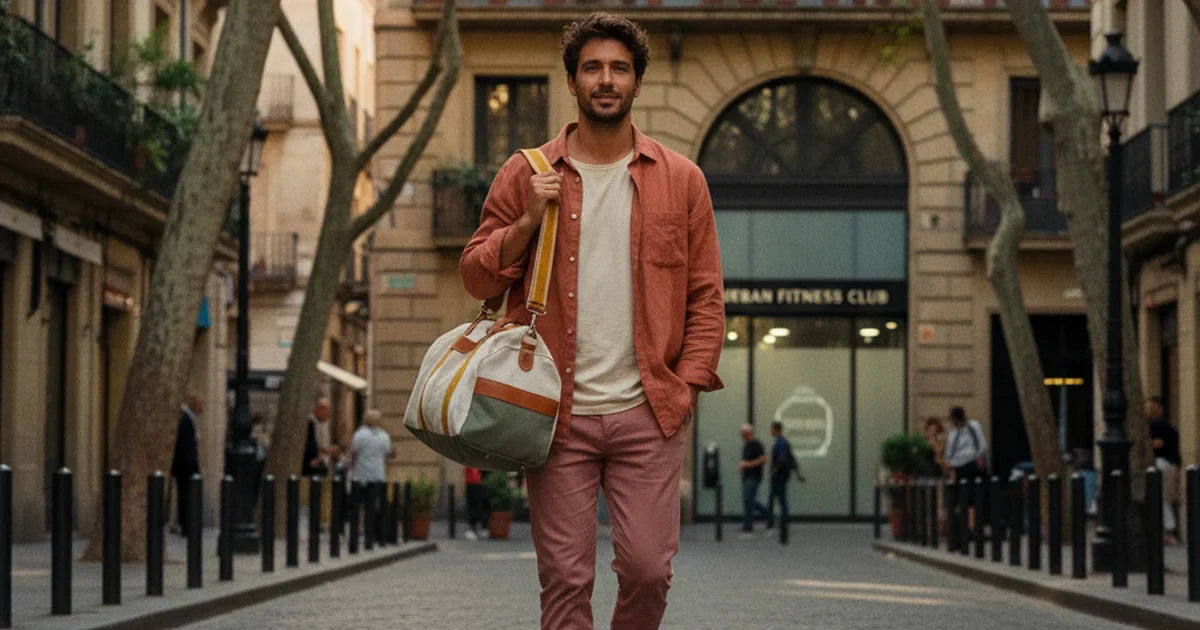
White t-shirt, clean joggers, neutral sneakers. Sports bag worn crossbody or on the shoulder. Favor sober colors: black, khaki, beige, burgundy. Avoid bright colors if you want the bag to match multiple outfits.
For work (sport + office)
Leather or waxed cotton canvas sports bag. Dark color. Carry it by hand or over the shoulder, with a jacket, dark jeans, clean sneakers, or derby shoes. The idea: the bag shouldn’t look like a gym bag.
For the weekend
Medium-sized duffel (35-45 L), natural color (khaki, beige, brown). You can fit your sports gear and a 2-day change of clothes. Maximum versatility.
Combinations to avoid
- Rigid plastic sports bag + suit = disaster
- Neon colors (fluorescent green, fluorescent yellow) if you’re not into competitive running
- Oversized brand logos if you want a discreet look
- Bag that looks new but already deformed = sign of a bad purchase
The 5 mistakes to avoid
Here are the classic pitfalls that make people throw away their sports bag after 6 months. Avoid them.
1. Choosing too small “to save space”
This is the most common mistake. You pick 20 L thinking it will be enough. Six months later, you struggle to close it as soon as you add a bath towel. Better to have 5-10 L too much than 5-10 L too little.
2. Choosing based on looks only
A bag that looks great but has no shoe compartment will end up in the closet within 3 months. Function comes first. Then, among functional models, choose the one you like aesthetically.
3. Neglecting the empty weight
An empty bag that already weighs 1.5 kg means you’re carrying 1.5 kg every day in addition to your stuff. Aim for an empty weight under 800 g for a 30 L bag, or under 1.2 kg for a 50 L.
4. Buying the cheapest
A €20 sports bag will tear or smell within a year. Expect to pay €50-150 for a good bag that lasts 3 to 5 years. That’s €30/year for hassle-free carrying versus €20 every 8 months of trouble.
5. Forgetting the warranty
Real sports brands (Adidas, Nike, Under Armour, Decathlon, etc.) often offer a 2-year warranty. Check before buying and keep your receipt. A zipper breaking after 14 months is frustrating—but if you have the warranty, it’s free.
How to care for your sports bag
Want your bag to last 5 years instead of 18 months? Here are the 4 care rules to follow.
Empty after each session
Wet laundry, shoes, towel: everything out as soon as you get home. Don’t leave anything in your bag between sessions. This is the number one cause of persistent odors and mold.
Air it out
Once a week, leave your bag open for a few hours in a ventilated room. If possible, outside (but not in direct sunlight). This allows residual moisture to evaporate.
Wash regularly
For nylon, polyester, or cotton bags: machine wash at 30°, gentle cycle, no spin. Air dry (never tumble dry). Once a month for heavy use, once every 3 months for moderate use.
For leather bags: clean with a damp sponge for dust, nourishing leather cream 2 to 4 times a year. Never use abundant water, never chemical products.
Repair rather than throw away
A broken zipper can be replaced (15-30€ at a cobbler). A loose seam can be sewn back (5-10€). A worn handle can be replaced. A quality bag is a long-term investment — better to repair it than throw it away.

In summary — How to choose your men's gym bag well
- Choose your capacity according to your sport: 20-30 L for weightlifting without shower, 35-45 L with shower, 50-70 L for team sports
- Check the compartments: separate shoes, wet pocket, valuables pocket, bottle pocket
- Choose a suitable material: recycled nylon or polyester for performance, waxed cotton canvas or leather for style
- Invest in quality: 50-150€ for a bag that lasts 3-5 years
- Maintain it: airing, emptying, regular washing — it will pay you back
The right men's gym bag is the one that fits your practice, not the other way around. Take the time to choose — you'll see it 200 times a year for 3 to 5 years.
Our Men's Sports Bags collection Duffel bags, backpacks, and compact sizes — Bokabas selectionFAQ — Everything to know about men's gym bags
What is the best men's gym bag brand?
There is no universal "best brand" — it depends on your use. For pure performance, Adidas, Nike, Under Armour, and Decathlon all make excellent nylon bags. For style + performance, brands like Patagonia, Aer, or Fjällräven are well known. For a versatile leather bag, look at brands specializing in sports leather goods. The most important criterion is how you will use it — not the logo.
What size gym bag should I take to the gym?
If you do your session without showering: 25-30 L enough (outfit, shoes, water bottle, towel). If you shower and completely change: 35-45 L is ideal. Beyond 50 L for weightlifting alone, you’ll be carrying empty space.
Backpack or duffel for sports?
Backpack if you come on foot, by bike, or if you combine sports + work during the day (both hands free). Duffel if you take the car or public transport, and if you prioritize capacity. For team sports, the XL duffel always wins.
What is the ideal weight of an empty sports bag?
Aim for less than 800 g for a 30 L bag and less than 1.2 kg for a 50 L bag. Beyond that, you’re carrying more bag than gear. Ripstop nylon bags are the lightest, leather bags the heaviest (1.5 to 2.5 kg empty).
How to avoid odors in your sports bag?
Three rules: empty it after each session, air it regularly, machine wash once a month (30°, gentle cycle). To absorb odors between uses, slip a baking soda sachet at the bottom. Avoid leaving wet clothes inside for more than a few hours.
Is a leather sports bag really useful?
If you want ONE bag that works for sports + office + weekend, leather is your best option. If you want a purely sports bag (intensive weightlifting, combat sports, swimming), leather is too fragile against moisture. Choose based on your main use.
What’s the difference between a sports bag and a travel bag?
The main difference: durability against moisture and internal organization. A sports bag has a separate shoe compartment, a wet pocket, and washable material. A travel bag focuses on organizing clothes and a more polished look. That said, versatile models (leather or waxed canvas duffels) do both very well.
Should you take a bigger bag "just in case"?
Yes, but not too big. Take 5-10 L more than your usual need. This allows you to manage weeks with more gear (competition, event, travel). But don’t take a 50 L bag for a 1-hour session in a nearby gym: you’ll carry it three times, then it will just sit in the closet.
Can you bring a sports bag in the airplane cabin?
Yes, if its dimensions do not exceed 55 × 40 × 20 cm (low-cost standard). Many 40-50 L duffel bags meet this standard. Check the exact dimensions before buying if you plan to travel with it.
How to wash a sports bag?
For synthetic materials (nylon, polyester): machine wash at 30°, gentle cycle, no spin. Air dry only, never use a dryer. Empty all pockets and remove any rigid removable parts before washing. For leather: use a damp sponge + nourishing lotion 2 to 4 times a year, never use a lot of water.
Also read: Complete Guide to Men's Travel Bags


Leave a comment
This site is protected by hCaptcha and the hCaptcha Privacy Policy and Terms of Service apply.