
Women's Vest: The Complete 2026 Guide (Long, Short, Sleeveless)

Looking for THE right women's vest? Long, short, mid-length, sleeveless, knit cardigan, quilted puffer - we'll help you find the vest that truly completes your wardrobe all year round.
You put on a shirt. It's a little chilly. You look for a vest. You pull out your long cardigan, and it makes you look shorter. You try your short vest, but it looks too much like a "shirt button." You try your sleeveless quilted vest, but it doesn't go with your outfit. You add a jacket, but it feels like too much. Classic.
A well-chosen women's vest is the layering piece that takes you from spring through fall. Lighter than a jacket and more structured than a blouse, it adds character and a little warmth without weighing you down. But with long knit vests, short quilted vests, chunky-knit cardigans, sleeveless puffer vests, and statement embroidered vests, how do you choose THE right one? This guide has all the answers.
What is a women's vest?
A women's vest is a garment that sits between a blouse and a jacket - less formal than a blazer, warmer than a shirt, and designed for layering. What sets it apart isn't a particular cut - you'll find knit, quilted puffer, velvet, and wool versions - but its function: wearing it over another piece (a shirt, lightweight sweater, or T-shirt) to add a little warmth, structure, or character without going as far as a jacket.
Historically, the vest came from the tailored suit vest (the piece worn under the jacket over a shirt). Today, it has become more accessible and varied. You'll now find long knit vests (boyfriend cardigan style), sleeveless quilted vests (cropped puffer style), long puffer vests, chunky-knit cardigans, and embroidered vests in an ethnic style. In short, there's a vest for every style and every season.

Its purpose, then: to be an all-season accessory that gives your silhouette structure. Spring: over a lightweight T-shirt. Mild summer days: over a blouse. Fall: over a lightweight sweater. Winter: under a coat for extra warmth. It works for 9 months out of 12.
Why a vest is the perfect layering piece
Before you understand the value of a vest, you tend to wear it the wrong way. Three seasons later, it clicks. Here are the four practical reasons a vest makes all the difference.
It adds a layer without adding bulk
This is the number one benefit. A jacket or coat feels like "too much" in between seasons. A blouse on its own is "not enough." A vest is just right: a little warmth, a little structure, without the bulk. You go out in it, you come home in it — that's the whole point.
It extends the wear of your clothes all year
A summer dress on its own = wearable from May to September. The same dress + a long knit cardigan = wearable from April to November. You extend the wear of your pieces. It's the most cost-effective clothing investment.
It adds structure to V- or T-shaped body types
For women with broad or defined shoulders, an open long vest creates a vertical line that visually balances the silhouette. It adds structure without bulk, without needing a proper coat.
It works under a coat in winter
A sleeveless quilted vest under a wool double-breasted coat is a classic winter layering combination. You stay warmer without looking bundled up. Many women rediscover this technique after a few years.
The 6 types of women's vests
Not all vests are created equal — or worn the same way. Here are the six main types, with their uses, strengths, and limitations.

The long knit cardigan
Mid-thigh to mid-calf length, knitted material (wool, merino, cotton), V-neck or round neck, sometimes with a belt. This is the boyfriend cardigan style you can wear over anything.
- Length: mid-thigh to mid-calf
- Ideal for: fall layering, casual chic looks, in-between days
- Key feature: comfort, absolute versatility, relaxed casual vibe
- Please note: can look bulky if too thick and takes up more space in your closet
This is the most versatile style. For your first long gilet, go for a cream, sandy beige, or gray fine knit. Versatile and durable for 5-8 years.
The short quilted gilet (with sleeves)
Waist to mid-hip length, quilted cotton fabric (visible padding), long sleeves, snap or zip fastening. Relaxed casual-chic vibe. Warmer than a simple shirt without being as heavy as a jacket.
- Length: waist to mid-hip (cropped)
- Ideal for: mid-season, youthful casual looks, versatile with jeans or skirts
- Key benefit: stylish, varied prints, affordable price
- Please note: less warm than a thick knit gilet in winter

A hybrid style between a gilet and a short jacket. Bokabas offers reversible versions (2 prints on the same garment). Ideal for mid-season.
The long sleeveless quilted gilet
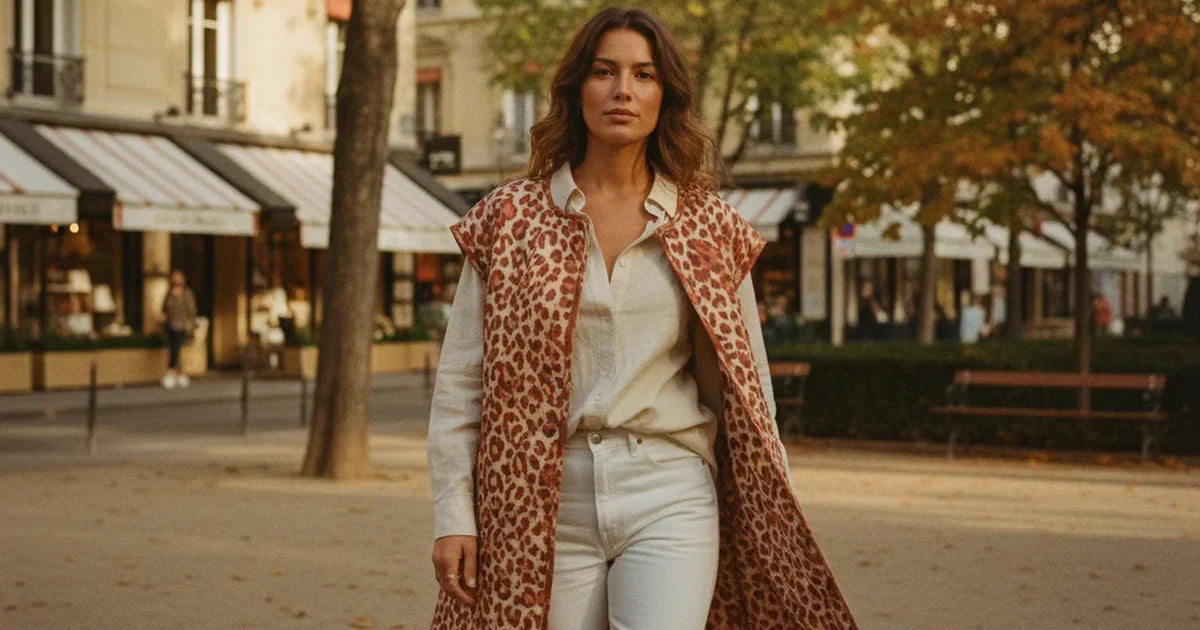
Mid-thigh to mid-calf length, quilted, sleeveless, open front or with a zip/buttons. It’s been the layering star for a few years now — the “long cropped puffer” worn over a sweater.
- Length: mid-thigh to mid-calf, sleeveless
- Ideal for: mid-season layering, stylish hiking, elegant outdoor vibes
- Key benefit: easy layering, sleeveless warmth without restrictive sleeves
- Please note: not warm enough to wear on its own in winter (wear over a long-sleeved sweater)
 Women's sleeveless quilted gilet Leopard
55.30€
View product
 Women's sleeveless quilted gilet Morris
55.30€
View product
 Women's sleeveless quilted gilet Pow
55.30€
View product
A style we love at Bokabas. Wear it over a lightweight sweater in fall, under a coat in winter, or over a shirt in spring. Available in several prints (leopard, Lolem, Morris, Pow, Febre).
The long puffer gilet
Long length (mid-thigh to mid-calf), very puffy quilting (puffer-jacket style), sometimes with a removable hood. The ultimate functional winter style.
- Length: mid-thigh to mid-calf, thick and puffy
- Ideal for: winter, practicality, city wear in extreme cold
- Key strength: exceptional warmth, water resistance, washable
- Worth noting: less dressy look, bulky to store
Choose black, navy or khaki for versatility. Avoid garish colors (orange, fuchsia) that quickly look dated.
The tailored vest / suit vest
A short (ends at the waist or just below), fitted, wool or wool-blend vest with a V-neck and front buttons. This is the smart sleeveless vest** worn over a shirt for a polished professional look.
- Length: waist-length, fitted
- Ideal for: formal professional settings, smart casual looks
- Key strength: maximum elegance, defines the torso, versatile with jeans or trousers
- Worth noting: formal look, less easy to style casually
A must-have if you often dress formally. Wear it over a white shirt or a fine-knit turtleneck. Expect to pay €50-120 for lasting quality.
The embroidered / statement ethnic vest
Mid-thigh to long, in cotton or viscose, with decorative embroidery (floral, geometric, ethnic). A boho-chic or contemporary statement vibe. The one-of-a-kind piece that transforms a basic outfit into a memorable look.
- Length: varies (mid-thigh to long)
- Ideal for: nights out, dinners, events, unique contemporary looks
- Key strength: a unique look, an instant statement
- Worth noting: less versatile for everyday wear and requires a little maintenance
Save it for occasional statement pieces. One beautiful piece is better than several average ones.
The 7 criteria for making the right choice
1. The length
This is THE defining feature of a vest. Short (ends at the waist or mid-hip): defines the upper body, makes your legs look longer, ideal for petite frames. Mid-length (mid-thigh): versatile and balanced. Long (mid-calf): creates a “light coat” effect, ideal for taller frames or adding structure to a full look.
2. Whether it has sleeves
With sleeves: warmer and more structured, but less versatile for layering over a long-sleeved sweater. Sleeveless: easy to layer over anything, more modern, ideal for mid-season.
3. The material
It should suit the main season you’ll wear it in. Fine knit for mid-season. Thick knit for fall and winter. Quilted for mid-season through mild winter. Puffer for extreme cold. We’ll go into more detail below.
4. The cut
Fitted: defines the waist, formal. Straight-cut: falls naturally, casual. Oversized: contemporary vibe, best worn with a flowy silhouette. Flared: adds structure to the top and movement to the bottom.
5. Fastening
Open (no fastening): easy layering, the most versatile. Buttons: classic, formal. Zip: modern, sporty. Belt: defines the waist, elegant. Snap buttons: casual and relaxed.
6. Color
Solid neutral color (cream, black, beige, khaki, navy) = maximum versatility. Saturated color (burgundy, sage green, terracotta) = personality without overwhelming your outfit. Bold pattern (leopard, floral, geometric) = an instant statement. For your first purchase, go for a neutral.
7. Comfort when putting it on
A cardigan should fit over a long-sleeved sweater without pulling at the shoulders. Always try it on over a sweater to check. Many “fitted” cardigans in stores are impossible to wear over another layer.
Which length suits your body type?
The right cardigan length depends on your body type. Here’s a handy guide.
If you’re petite (under 1.65 m)
Choose a short cardigan (no longer than mid-hip) or a mid-length one (ending just below the bottom). Avoid very long cardigans, which can make you look shorter. A sleeveless quilted vest ending mid-thigh works very well.
If you’re of average height (1.65–1.72 m)
You can wear any length. A mid-length cardigan (mid-thigh) is the ideal option for your body type—balanced and versatile.
If you’re tall (over 1.72 m)
You can opt for a long cardigan (mid-calf length) to balance your tall silhouette. Avoid very short cardigans, which can make your torso and legs look “unbalanced.”
If you have an hourglass figure (defined waist)
Go for a fitted cardigan or one with a belt that highlights your waist. A knit cardigan with a belt tied at the waist or a fitted blazer-style cardigan works very well.
If you have an H-shaped body (little waist definition)
Choose a straight-cut cardigan that doesn’t emphasize the waist. A long, fluid-knit cardigan or a long sleeveless quilted vest adds structure without artificially highlighting your waist.
If you have a V-shaped body (broad shoulders)
Go for a straight or flared cardigan that doesn’t emphasize the shoulders. A long, open cardigan with a fluid vertical line visually balances the shoulders.
If you have a pear-shaped figure (wider hips)
Choose a long cardigan that falls below the hips (at least mid-thigh). Avoid cardigans that end halfway down the hips—they create an unflattering “cut-off” effect.
Which material to choose
Each material has its own sweet spot.
Knitted fabric (classic cardigan)
The go-to material for long cardigans. Pure wool (more expensive, warmer), merino (soft, non-itchy), cotton (summer), polyester blends (more affordable).
- Advantages: exceptional comfort, versatile, casual chic vibe
- Limitations: may pill over time, requires careful maintenance
- Ideal for: fall layering, casual chic outings
- Season: spring, fall, mild winter
Quilted cotton
The go-to material for quilted vests. Lightweight, comes in a variety of patterns, and is machine washable for most styles. Provides a little warmth without being too warm. Affordable.
- Advantages: affordable, varied patterns, washable, durable
- Limitations: less warm than a chunky knit in winter
- Ideal for: transitional weather, layering, casual chic looks
- Season: spring, fall, mild winter
Technical polyester (puffer)
For puffer vests. Very warm, water-repellent, lightweight, washable. Less dressy look.
- Advantages: warmth, water repellency, lightness
- Limitations: less dressy look, takes up storage space
- Ideal for: practical winter wear, the city in very cold weather
- Season: winter
Wool or wool blend
For tailored vests. Structured, elegant, warm. Available in pure wool (more expensive) or blends (wool + polyester, more affordable).
- Advantages: structure, elegance, warmth
- Limitations: care (often dry-clean only), higher price
- Ideal for: formal professional looks, dressy occasions
- Season: fall, winter, cool spring
Velvet / corduroy
Chic look, fall-winter vibe. Soft to the touch, elegant. Available in corduroy (more casual) and smooth velvet (dressier).
- Advantages: unique look, chic vibe
- Limitations: more delicate care
- Ideal for: chic fall-winter outings
- Season: fall, winter
What to avoid in a cardigan
Cheap, highly synthetic fabrics that pill within 6 months. Ultra-seasonal prints (neon camouflage, pop patterns). Sequins that come off after the first wash.
How to style it
A cardigan goes with almost anything—here are the combinations that work.
With jeans
L's most versatile pairing. High-waisted jeans + long knit vest = an effortlessly chic, balanced silhouette. Straight-leg jeans + sleeveless quilted vest = transitional-season layering. Wide-leg jeans + short quilted vest = contemporary vibe.
With a dress
Midi dress + long knit vest = a classic, understated combination. Maxi dress + sleeveless quilted vest = layering that extends the dress-wearing season. Short dress + long cardigan = a "light coat" effect with a chic look.
With a skirt
Pleated midi skirt + long knit vest = boho chic vibe. Short skirt + short tailored vest = polished professional look. Long skirt + long flowing knit cardigan = contemporary vibe.
With pants
High-waisted pants + long sleeveless quilted vest = a structured silhouette. Palazzo pants + long cardigan = an elegant contrast of fluidity and vertical lines.
For winter layering
Fine turtleneck + sleeveless quilted vest + long wool coat = classic Parisian winter outfit. You'll stay warm without looking bundled up.
Avoid unfortunate pairings
A vest that's too long with a short skirt: an unbalanced visual effect. A thick vest over a fitted lightweight tee: the effect of "getting lost in the vest." Always aim for consistent thickness between the vest and the piece underneath.
Sleeveless vest vs. sleeved vest
This is THE question. Which style should you choose?
When a sleeveless vest wins
- You're looking for versatile layering (wearable over a long-sleeved sweater)
- You want a versatile transitional-season piece
- You're looking to structure an outfit without adding bulk
- You often wear it indoors (sleeves get in the way when typing on a keyboard)
- You want a modern piece (cropped puffer vibe)
When a sleeved vest wins
- You're looking for more warmth than a sleeveless vest
- You want a standalone piece (without having to wear something underneath)
- You wear it more in really cold winter weather
- You prefer consistent comfort without the transition across the sleeves and shoulders
Our stance at Bokabas
We love sleeveless quilted vests for their versatility. They're our favorite vest style - you can wear one over anything (sweater, shirt, blouse, dress) in any season. More versatile than a sleeved vest that "locks" you into one look.
If you're only buying one vest, go for a quilted vest in a neutral color or subtle pattern (stylized leopard). You'll get the most versatility for 9 months of the year.
The 5 mistakes to avoid
1. Buying a vest that's too thick for the season
A thick, chunky-knit vest in April is too much. A thin quilted vest in the middle of winter isn't enough. Choose the thickness based on the season you'll wear it most.
2. Sacrificing knit quality
A low-quality cardigan pills after just 5 wears. Better to buy an €80 merino cardigan that lasts 5 years than a €25 synthetic-blend one that lasts 4 months.
3. Choosing based only on a pattern you "like"
A bold pattern can look great but be hard to wear every day if nothing in your wardrobe matches it. Go for a pattern that you already have plain bottoms to wear with so it feels natural.
4. Buying "too oversized"
L'ooking "lost in the vest" overwhelms a petite or medium-height frame. Aim for a fit that's fitted at the shoulders (the shoulder seam aligned with your shoulder), with a little room in the body if you want comfort.
5. Buying without trying it on over a layer
Many cardigans that look "gorgeous in the store" are impossible to wear over a sweater in winter. Always try it on with a layer similar to what you plan to wear it with.
How to care for your vest
For a knitted vest (cardigan)
- Daily care: air out, gently brush to remove lint/pills
- Washing: hand wash in cold water or machine wash on the wool cycle at 30° in a protective mesh bag
- Drying: flat on a drying rack, never on a hanger (the weight will stretch the knit)
- Storage: folded, never on a hanger (to prevent the shoulders from losing their shape)
For a quilted cotton vest
- Daily care: air out, gentle brushing
- Washing: machine wash at 30° in a protective mesh bag (check the label)
- Drying: flat or on a padded hanger, never in the dryer (the padding may flatten)
- Storage: on a padded hanger
For a polyester puffer vest
- Daily care: no care needed
- Washing: machine wash at 30° with mild detergent, two tennis balls in the drum to preserve its puffiness
- Drying: flat or on a wide hanger
- Storage: on a wide hanger to preserve its puffiness
For a wool tailored vest
- Daily care: air out, soft brush
- Regular care: dry-clean once or twice a year
- Moth protection: cedar or lavender sachets during the off-season
- Storage: padded hanger, cotton cover
In case of stains or pilling
- Fresh stain: Blot (never rub), mild soap + cold water
- Pilling: run a fabric shaver or a special pumice stone for textiles over it in the direction of the knit
- If the knit stretches: gently steam it (hold the iron 30 cm away) to reshape it
FAQ — Everything you need to know about women's vests
What length of women's vest should you choose?
It depends on your body shape. Petite (< 1m65): short or mid-length vest, no longer than mid-thigh. Average height (1m65-1m72): mid-length vest (mid-thigh)—the most versatile length. Tall (> 1m72): can wear a long vest (mid-calf) to balance the silhouette. Always avoid a vest that ends halfway across the hips—it creates a cropped effect.
Sleeveless or sleeved vest: which should you choose?
The sleeveless vest is more versatile for layering (wear it over a long-sleeved sweater). The sleeved vest is warmer on its own but less versatile. For your first purchase, go for the sleeveless option—it works for 9 months of the year. A sleeved vest is still a good addition for chilly days when you need a layer of its own.
What material should you choose for a women's vest?
Knitted fabric (merino, wool, cotton): comfortable and versatile—for long cardigans. Quilted cotton: fashionable look, affordable price—for quilted vests. Puffer polyester: practical warmth—for very cold winters. Wool: structure for tailored vests. Velvet: a chic look for going out.
Which vest should you choose for in-between seasons?
The sleeveless quilted cotton vest is unbeatable for in-between seasons (spring and fall). It keeps you a little warm without being too heavy, comes in a variety of patterns, and is machine washable. The long, fine-knit cardigan is also an excellent choice—wear it over a T-shirt or blouse.
How do you wear a long vest with jeans?
High-waisted jeans + an open long vest = a balanced silhouette. Wear a thin T-shirt or blouse tucked underneath. The vest should fall below the hips (at least mid-thigh) to avoid a cropped effect. For a smart-casual look, add flat ankle boots and a quilted tote bag.
Long vest or long cardigan: what's the difference?
It's the same type of garment. The term "vest" is used more often for pieces made from non-knit fabrics (quilted fabric, structured wool, velvet). The term "cardigan" comes from English and historically refers to knitted garments. Both describe a garment that opens at the front and is worn over another layer.
How much does a good women's vest cost?
Budget €40 to €80 for a long merino wool cardigan or a quality cotton quilted vest. €70 to €150 for a signature quilted vest (Bokabas €79) or a wool-blend tailored vest. €150 to €300 for pure cashmere, leather brands, or designer pieces. Under €30, the knit or stitching quality is generally inadequate.
What color vest should you choose?
For your first vest: neutral color (cream, sand beige, black, khaki, charcoal gray) - goes with everything. For a second vest: saturated color (burgundy, sage green, terracotta, navy) - adds color without overwhelming the look. For an occasional statement vest: bold pattern (leopard, floral, toile de Jouy).
Can you wear a vest over a dress?
Yes, absolutely. Midi dress + long knit vest = a classic combination. Maxi dress + sleeveless quilted vest = layering that extends the season. Short dress + long cardigan = a "light coat" effect for a chic look. For consistent proportions, the vest should end below the hem of the dress.
How do you prevent a vest from pilling?
Three rules: 1) Wash it rarely (by hand or on the machine's wool cycle only when really necessary). 2) Avoid rubbing it against rough fabrics (sturdy canvas bags, scratchy scarves). 3) If bobbles appear, use a fabric shaver in the direction of the knit - not a regular razor, which can cut the fibers. A textile pumice stone also works very well.
The Bokabas selection
At Bokabas, we offer a lovely selection of women's sleeveless quilted vests. Mid-length (falls to mid-thigh), a variety of patterns (leopard, floral, geometric), and affordable prices (€79). Ideal for mid-season layering over a sweater or shirt.
Leopard Women's Sleeveless Quilted Vest
79€
View product
 Febre Women's Sleeveless Quilted Vest
79€
View product
 Lolem Women's Sleeveless Quilted Vest
79€
View product
You can also browse our women's jacket section for short quilted jackets with sleeves that pair well with sleeveless vests in a layered wardrobe.

Women's Vests Collection
6 styles available
DISCOVER THE COLLECTION---



Leave a comment
This site is protected by hCaptcha and the hCaptcha Privacy Policy and Terms of Service apply.