

Block printing: The textile printing technique inspiring fashion

Block printing is a textile printing technique using carved wooden stamps. Originating from India, it produces unique patterns on cotton, linen, or silk. Highly popular in bohemian and contemporary fashion, it charms with its colorful prints and singular character. This guide explains everything: origins, techniques, how to recognize genuine block print, how to wear it, and how to care for it.
What is block printing?

Block printing (or stamp printing) is a manual fabric printing process. The principle is simple: a carved wooden block — called bunta in Hindi — is dipped in ink or dye, then pressed onto the fabric. Pattern after pattern, the textile is covered with a repetitive print, but never quite identical from one press to the next. It is this slight irregularity that gives block printing its charm compared to industrial printing.
Contrary to what one might think, block printing is not limited to a simple stamp placed on fabric. The pressure must be constant, the inking precise, and each pattern must align with the previous one to the millimeter. An experienced artisan can apply several hundred stamp impressions per day to cover a single meter of fabric — a work of patience that gives block printing its value and uniqueness.
An ancient technique, still alive
Block printing dates back over 4,000 years. The first traces were found in Egypt and Mesopotamia, but it was in India — in Rajasthan and Gujarat — that the technique was perfected and passed down through generations. Even today, regions like Jaipur, Sanganer, and Bagru are globally recognized for the quality of their printed textile production.
The technique also developed in Japan (katazome), China, and Indonesia (stamped batik), with each region bringing its own patterns and processes. In Europe, block printing inspired printed Provençal fabrics and the famous 18th-century "Indiennes" — printed cottons imported from India that revolutionized European fashion.
Block print vs screen printing vs digital printing
It is important to distinguish block printing from other textile printing techniques, especially when buying online:
| Technique | Process | Result | Uniqueness |
|---|---|---|---|
| Block print | Wooden stamp, manual application | Organic, slightly irregular | Each piece is unique |
| Screen printing | Screen and squeegee, semi-mechanical | Uniform, precise | Mass production |
| Digital printing | Computer-controlled inkjet | Clean, identically reproducible | No variation |
Block printing stands out for its lively and textured appearance. A block-printed fabric is recognized by its slight misalignments between patterns and the variable ink thickness — "imperfections" that give it its full value and that mechanical printing cannot reproduce.
Block Printing Techniques
Direct Printing
This is the most common and accessible method. The block is dipped into a tray of colored dye, blotted on an inking pad, then pressed firmly onto the fabric stretched out on a padded table. This gesture is repeated hundreds of times to cover a single meter of fabric.
The inks used are traditionally of vegetable or mineral origin: indigo for blue, madder for red, turmeric for yellow, pomegranate for black. Today, many producers also use certified non-toxic reactive pigments, which allow for brighter colors and, more importantly, greater resistance to repeated washing.
Resist Technique
In this more complex variation, the artisan first prints a resist paste (wax, mud, or resin) onto the fabric using the stamp. The textile is then immersed in a dye bath: the areas protected by the resist do not take on the color. After removing the resist, the pattern appears in negative — meaning the design remains the original color of the fabric.
The dabu technique (a mud-based resist mixed with gum) is one of the most well-known. The fabric is printed with mud, sun-dried, dyed in an indigo or madder bath, then washed to reveal the pattern. The result is subtle and elegant, with earthy and natural tones highly sought after in both decoration and fashion.
The Blocks: Carving and Design
Each block is carved from hardwood — teak, rosewood, or sheesham (Indian rosewood). A specialized engraver carves the negative pattern using chisels, gouges, and small knives. The work requires extreme precision: the finest lines are less than a millimeter wide. A quality block can last 20 to 30 years with proper care — simply clean it after each session and store it in a dry place.
Patterns range from floral to geometric, including paisley, mandalas, and animal motifs. A complex design often requires several blocks: one for the outline, one for filling, one for details. Colors are printed one by one, with each pass requiring intermediate drying. A multi-color fabric can require 5 to 8 successive passes — which explains the higher price of pieces with complex patterns.
Free shipping from €60 · Block print patterns · Durable cotton
How to recognize genuine block print

With the increasing popularity of block printing, many imitations are circulating — mechanical prints that reproduce the block print "look" without the technique. Here's how to distinguish genuine block print from an industrial copy.
Signs of authenticity
- Slight misalignments: patterns are never perfectly aligned, unlike mechanical printing. Look at the junctions between two stamp impressions: a slight overlap or a gap of a few millimeters is normal
- Variable ink thickness: some areas are darker than others, a sign of manual pressure. The edges of the stamp sometimes leave a more intense mark than the center
- Fabric reverse side: on a genuine block print, the color partially penetrates through the fabric — the pattern is visible on the back, even if less clear. On industrial prints, the reverse side often remains white or very pale
- Texture to the touch: block print ink sometimes leaves a very slight relief, especially on solid color areas. Run your finger over the pattern: if you feel a micro-thickness, that's a good sign
- Pattern edges: slightly blurred or organic, never as sharp and crisp as in screen printing or digital printing
Quality of the base fabric
The textile base is as important as the print itself. Quality block print is usually made on natural cotton — voile, poplin, cambric, or mulmul (very fine Indian muslin) — which absorbs dyes well and provides a clear finish. The fabric should be soft, breathable, and have a natural feel. If the fabric is stiff, shiny, or synthetic, there is a strong chance that the print is not genuine block print.
The thickness of the cotton also influences the result: a fine cotton voile (mulmul) gives an airy and transparent finish, while a thicker poplin offers more saturated colors and a more structured fabric — better suited for bags, jackets, and everyday accessories.
Block printing in current fashion
Block printing is experiencing a significant revival in contemporary fashion. Long confined to bohemian or ethnic styles, it is now found in various genres: casual chic, ethical fashion, streetwear, colorful minimalism, and even interior design.
Why this enthusiasm?
Several factors explain the success of block printing in current fashion:
- Uniqueness: in a fast fashion world where everything looks alike, block printing brings a unique character to each piece. No two patterns are perfectly identical — it's the ultimate anti-uniformity
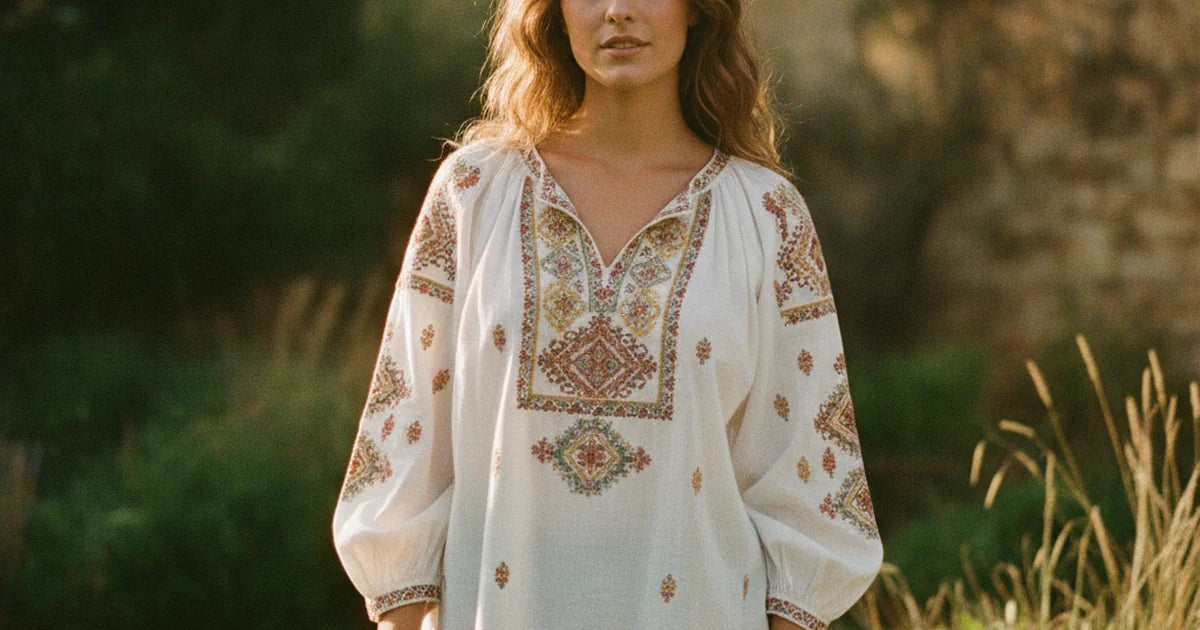
- Versatile aesthetic: the floral, geometric patterns and vibrant colors of block printing fit equally well into a bohemian style or a refined urban look
- Varied products: block printing is found on jackets, bags, pouches, dresses, shirts, home linen, and even accessories like tote bags and market bags
- Durability: a quality block print textile lasts for years. Colors develop a patina and character over time, unlike industrial prints that fade
Most popular patterns
- Floral: roses, lotuses, stylized daisies — the most common and versatile, they adapt to all styles
- Geometric: lines, diamonds, chevrons, grids — a more graphic and contemporary style, perfect for accessories
- Paisley (cashmere): the recognizable teardrop shape, mixing tradition and elegance. Omnipresent in scarves and jacket linings
- Mandalas: circular and symmetrical patterns, strongly associated with bohemian style and interior decoration
- Animals: birds, elephants, peacocks, fish — figurative patterns that tell a story and give character to pieces
How to wear block print every day

Incorporating block print into your style is simpler than it seems. The golden rule: don't overdo it. Just one block print piece is enough to add character and color to an entire outfit. The rest should remain simple to let the pattern breathe.
Successful combinations
- Block print + basics: a printed tote bag with jeans and a white t-shirt. The bag adds a touch of color without overpowering the silhouette
- Block print + denim: a printed jacket over raw denim creates an interesting contrast between the pattern and the simplicity of the denim. The easiest combo to wear every day
- Block print + neutral tones: pair your printed pieces with beige, off-white, camel, or black for an elegant and balanced look
- Block print accessories: a colorful pouch, a printed tote bag, or a clutch are enough to elevate a simple look without taking risks
Mistakes to avoid
- Mixing several block print patterns in the same outfit — unless you master mix & match and the colors complement each other
- Pairing block print with other very busy patterns (leopard, large checks, tie-dye) — the result quickly becomes confusing
- Overloading: one strong piece is enough. If you wear a printed jacket, the rest of the outfit should remain plain
Free shipping from €60 · Block print cotton · Exclusive designs
Care for block print textiles
A well-maintained block print textile lasts for years, and the colors gain a patina without fading. The precautions are simple but important, especially for the first washes.
First wash: the most important
The first wash sets the colors and removes excess dye. Wash your block print item alone, by hand, in cold water, with one tablespoon of white vinegar per liter of water. Vinegar sets the pigments and prevents bleeding in subsequent washes. Don't worry if the water discolors slightly — this is normal and doesn't mean the fabric is losing its color. It's the surface excess that's washing away.
Subsequent washes
- Temperature: always cold or 30°C maximum. Heat causes dyes to bleed, especially natural pigments
- Detergent: mild soap, no bleach or whitening agents. A liquid Marseille soap works very well
- Machine: possible on a delicate cycle, turning the garment inside out in a laundry net
- Drying: always air dry, in the shade. Prolonged direct sun can fade colors over time
- Ironing: medium iron, preferably on the reverse side. Direct heat on the ink can alter the brightest colors
Stains and routine care
For a fresh stain, dab with a damp cloth without rubbing — rubbing spreads the stain and can discolor the printed area. For stubborn stains, a little Marseille soap applied locally before washing usually does the trick. Avoid chemical stain removers (bleach, chlorine-based products) which risk creating a discolored halo on the fabric.
Over time, the colors of an authentic block print evolve: they soften slightly and gain character, much like raw denim that develops a patina. This is a sign of quality, not deterioration.
FAQ: Block Print
What is block print?
How to recognize a true block print?
Does block print bleed when washed?
What is the difference between block print and batik?
How to care for a block print garment?
On which fabrics is block print made?
Is block print eco-friendly?
Can you do block print yourself?
Key takeaways
- Block print is a manual wooden block printing technique, originating from India, over 4,000 years old
- Recognizing a true one: slight misalignments, variable ink, color visible on the reverse side of the fabric
- Three techniques: direct printing, resist (resist/dabu), and regional variations
- How to wear it: one printed piece + plain basics = the most effective combo
- Care: first wash with white vinegar, then machine wash 30°C delicate cycle, dry in the shade

Our printed cotton bags
Tote bags and travel bags with colorful patterns.
Discover the collectionFree shipping from €60 · Free returns within 30 days



Leave a comment
This site is protected by hCaptcha and the hCaptcha Privacy Policy and Terms of Service apply.